
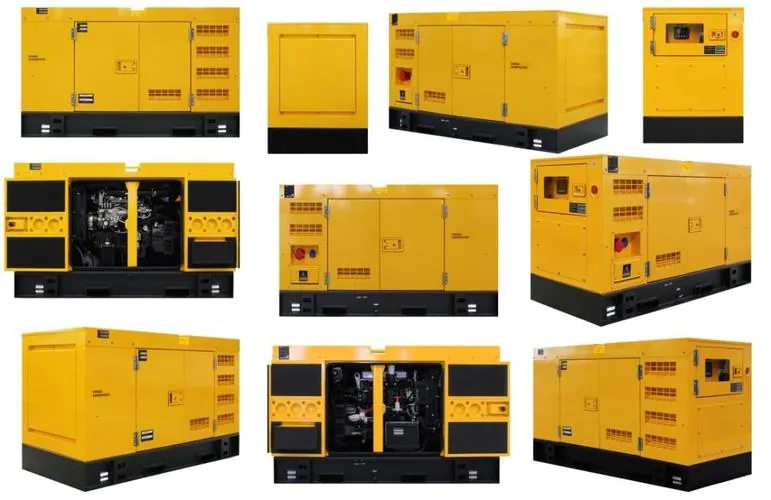
Flat rack OOG genset shipping is what happens when a generator set is wider, taller or heavier than a closed box will accept. Three numbers decide it: declared width, declared height and declared weight. Tesla Power Equipment publishes all three on the drawing.
- Width fails first. A 40 ft box takes 2,340 mm through its door and nothing wider.
- Weight fails second, at a level most buyers do not see: the in-gauge payload, not the frame limit.
- Height is what an open top or a flat rack buys back, at the cost of a crane at both ends.
- Declaration is the trap. Cargo is out of gauge when the numbers do not match.
What counts as out of gauge on a genset?
Out of gauge is a booking category, not a remark about the machine. Each carrier publishes the largest cargo it will take on a given equipment type as an ordinary booking, and anything past that is re-rated. Maersk lists in-gauge limits of 1,163 cm by 244 cm by 194 cm at 34,500 kg for a 40 ft flat rack, and 1,181 cm by 219 cm by 234 cm at 28,600 kg for a 40 ft open top. Our export generator sets cross one of those lines sooner than most buyers expect.
Two of those four numbers do the work. A 40 ft flat rack takes 244 cm of width, or 2,440 mm, while a 40 ft open top takes only 219 cm, or 2,190 mm. The open top is the taller box and the narrower one, so the choice is between room where you need it and room where you do not.
What the carrier's in-gauge table actually lists
The table is short and it is the whole test: four equipment types, four sets of dimensions, one payload figure each, and no reference anywhere to a generator set. It was written for boxes.
- The booking is re-rated as out of gauge and the freight is quoted again.
- Handling charges and a Misdeclaration Fee of USD 500 can follow, and the terminal may refuse to load.
A discrepancy is enough on its own. The carrier states that any discrepancy in a special cargo declaration results in it being considered out of gauge, so a booking made on estimated dimensions is one waiting to be re-rated.
Tesla Power issues that drawing with the order rather than with the shipment. It carries the overall dimensions with the radiator, the exhaust and the control panel fitted, because a set measured without its exhaust is a different machine. Ask for it before the freight is booked.
Where does the width limit actually bite?
Width is the number that decides everything else, because height can be bought back with an open top and weight spread across a frame, but width cannot be negotiated. Every 40 ft box has a door opening close to 2,340 mm.
The door is narrower than the box
Run the comparison on real machines. A 100kVA open set is 2,268 mm long, 1,094 mm wide and 1,576 mm high, and clears a 40 ft door on every dimension. A 2,000kVA class set with its radiator mounted measures 6,175 mm long, 2,286 mm wide and 2,537 mm high: the width clears 2,340 mm by 54 mm, and the height clears a 2,577 mm door by 40 mm. Both come from the C2000 D5 data sheet and are typical values for that model.
That 40 mm is tolerance, not margin. Door openings differ by about 20 mm between owners, Hapag-Lloyd publishing 2,597 mm where Maersk publishes 2,577 mm for the same 40 ft high cube, so a machine quoted against the larger figure cannot be booked against the smaller. Measure the crate.
The container's own outer dimensions are set by ISO 668, which classifies series 1 freight containers by external dimension and rating. That is why a containerised 1,500kVA set at 12,192 mm by 2,438 mm by 2,896 mm is not cargo that fits a 40 ft high cube.
Flat rack, open top, or standard container?
Once width is settled, the question is how much height you need and how much weight you carry, because the special types trade one against the other. A 40 ft standard container carries slightly more payload than a high cube.
| Equipment | In-gauge L x W x H | Payload | Buys you |
|---|---|---|---|
| 40 ft open top | 1,181 x 219 x 234 cm | 28,600 kg | Loading from above |
| 40 ft open top HC | 1,181 x 219 x 265 cm | 28,600 kg | 31 cm more height |
| 40 ft flat rack | 1,163 x 244 x 194 cm | 34,500 kg | Width, height capped at 194 cm |
| 40 ft flat rack HC | 1,163 x 244 x 226 cm | 34,500 kg | Same width, 32 cm more |
| 40 ft high cube | door 2,340 x 2,577 mm | 28,600 kg | Cheapest, ruled out first |
Read the height column twice, because it is where flat racks lose. A flat rack's in-gauge height is 194 cm, lower than the 234 cm of an open top, so moving to a flat rack to gain width costs you height. The frame's structural loading height is about 1,957 mm above the floor, and anything above that is declared and stowed as overheight.
Tesla Power sees the same mistake in most first enquiries: a buyer asks for a flat rack because the set is wide, then finds the canopy is 2,315 mm tall and the flat rack will not take it in gauge. The open top suits a tall enclosed machine; the flat rack suits a wide open skid, and a flat rack OOG genset for mining duty is usually the second. Our container loading notes cover the ordinary case first.
How the declared weight changes the maths
Weight behaves differently from width, because the number that governs it is the in-gauge payload rather than the structural limit of the frame. A 40 ft flat rack is built to a maximum gross mass of either 45,000 kg or 52,500 kg depending on the batch, but the carrier accepts only 34,500 kg on an ordinary booking.
Work it through on a real machine. The 17,147 kg wet weight of a 2,000kVA class set is 17,147 / 28,600 = 60% of the in-gauge payload of a 40 ft high cube, which leaves 40% for the cradle, the dunnage and the lashing steel. That margin is thinner than it looks.
- Weigh the set with fluids in, not dry, and record the figure on the drawing.
- Add the cradle, the dunnage and the lashing steel as separate declared items, and check the concentrated load limit.
A 1,250kVA open set at 10,069 kg wet sits inside every allowance in the table. Tesla Power records wet weight on every order, and that record is what goes on the booking.
Lashing on a flat rack: the weakest link
Lashing is where a flat rack stops being a container and becomes a frame with holes in it. The lashing eyes are generally rated at 5,000 kg, and the carrier's own guidance names them the weakest link. Maximum securing load is taken as 50% of the breaking load of the lashing, so a web lashing sold on a 10,000 kg break figure secures 5,000 kg.
That arithmetic decides how many lashings you need, and it runs per lashing rather than per machine. A 17,147 kg set does not need four; it needs the number the calculation gives, signed before the unit is released. Our lifting and packing sequence produces those lines as a by-product.
Dunnage, lashing eyes and the 30 cm rule
Wood dunnage or an anti-slip material such as rubber must sit between a metal cargo and the bottom rails. The friction it adds reduces the number of lashings the calculation demands.
- Spread the load along the rails, not across one point.
- Keep over-width cargo and its blocking out of the 30 cm nearest the front end.
- Re-check the lashing after the first road move, before the terminal.
No published figure sets a limit for how high the centre of gravity may sit, so treat any number quoted for it as unsourced. The requirement is qualitative: the centre of gravity must not be too far off centre. Every terminal works to the CTU Code.
How flat rack OOG genset shipping is booked and priced
Flat rack OOG genset shipping is quoted rather than tariffed, and the ocean leg is only one line. The crane at each end, the over-width road permit and the lashing plan arrive as separate items, and a quotation carrying a single number usually covers the first alone.
Flat rack OOG genset manufacturers and freight forwarders answer to different scopes: the first builds and packs the machine, the second owns everything after the gate. China flat rack OOG genset suppliers usually quote the ocean leg and stop there, which is why two quotations that look comparable often do not cover the same work.
The freight moves weekly. Drewry's World Container Index put Shanghai to Rotterdam at US$3,997 per 40 ft on 10 September 2026, and the Freightos Baltic Index put China and East Asia to North Europe at US$4,373 per 40 ft around 3 September 2026. Both are spot readings about a week apart, so US$4,000 to US$4,400 is a planning band and not a quotation. Tesla Power quotes the equipment line separately.
What the destination has to be able to do
The constraint that decides a project usually sits at the discharge end rather than at sea. A flat rack arrives on a vessel that can lift it, then has to move on roads that were not built for it, by a crane that may not exist locally.
- Confirm crane capacity at discharge before the equipment is booked, in writing.
- Measure the site gate and turning circle against the crate, not the machine.
Our help and advice pages cover the site-side questions we get most often. A discharge port with one mobile crane sets a hard ceiling on what can be landed, months before any vessel is fixed.
Documents that decide whether it clears
An out-of-gauge booking carries a documentation load an ordinary container does not. The declared dimensions and weight have to appear on the same documents the terminal and the customs authority read, and a difference can hold the cargo.
The dimensional drawing does the heavy lifting, and it has to match the packing list line by line. A list reading one generator set tells a terminal nothing; one reading a set, a cradle and a spares case, each with dimensions and weight, can be checked in a minute.
Keep the flat rack OOG documentation for customs in the same folder as the drawing, because the terminal and the customs authority do not read the same page of it. Conformity assessment for the shipment is a separate exercise. Tesla Power sends both folders as one package.

Photographs are part of the file. Shoot the machine on the cradle before it is wrapped, the lashing after it is tensioned, and the sealed flat rack with its number in frame. Where a set travels on export shipping documents naming a serial number, the photograph ties that number to the steel.
When a container is no longer the answer
There is a point where the box stops being the cheapest answer, and it is reached on dimensions rather than weight. A containerised 1,500kVA set is already a 40 ft high cube, so it is not loaded into one; it travels as a unit lifted by its own corner castings. Above that, the machine is built as a skid or a station and moves as break bulk on a vessel with the gear to take it.
Yangzhou Tesla Power builds both forms, and the decision belongs at the enquiry stage rather than the booking stage. A set designed as a container from the start ships on ordinary equipment and arrives weatherproof. The same rating built as a skid needs a flat rack and a tarpaulin, and is cheaper only where the site was going to enclose it anyway.
- Under 2,340 mm wide and 2,570 mm tall: a closed high cube.
- Taller than the door but inside 2,190 mm: an open top.
- Wider than 2,340 mm and under 194 cm tall: a flat rack.
Frequently asked questions
What does out of gauge actually mean for a generator set?
A booking category, not a description of the machine. A carrier publishes the largest cargo it will accept on each equipment type as an ordinary booking, and a set outside those dimensions is re-rated and quoted again.
Is a flat rack the answer for every large set?
No, and it is often the wrong one. A flat rack gives more width and payload than an open top, but its in-gauge height is lower, so a tall enclosed set that fits an open top may not fit a flat rack.
How much does an out-of-gauge shipment add to the freight?
No single figure, because the additions are separate line items rather than a percentage: the crane at each end, the road permit, the lashing plan and any positioning leg, each priced on its own.
Why does a 40 ft high cube carry less than a standard container?
Both share a maximum gross mass of 32,500 kg, and the high cube is the heavier empty box by roughly 180 to 200 kg. That comes off the payload, so a standard 40 ft container carries slightly more.
Can I book on estimated dimensions and correct them later?
You can, and it is the most expensive habit in this trade. The carrier treats any discrepancy between declaration and cargo as out of gauge, which can bring a misdeclaration fee, and the terminal can refuse to load.
Who is responsible for the lashing calculation?
The packer is, in practice, and the contract should say so by name. The calculation runs per lashing rather than per machine, using half the breaking load of each, and has to be signed before release.
Do I need different insurance for out-of-gauge cargo?
Usually yes, because the exposure changes rather than the value. An open flat rack leaves the machine exposed to weather and to handling by crane, and an over-width road move adds a permit that can be withdrawn. Tell the insurer the equipment type and the route, and get the answer in writing.
One check is worth doing before the next enquiry goes out. Open the drawing for the set you are buying and read the width with the canopy fitted rather than the skid. If it is over 2,340 mm, the freight quotation you are comparing was priced for a box your machine cannot enter, and the difference will surface at the terminal rather than at the negotiation. Ask our export desk for the drawing and the packing list together, and Tesla Power Equipment will return both before you book the vessel.