
Diesel generator derating altitude reduces the real output a set can deliver on a highland site, and the calculation has to follow the engine data sheet. Tesla Power's engineering team works the derate into every export quote so buyers can compare ratings against their load list before they order a 500kVA set.
- Pull the engine data sheet for the altitude and ambient derating curve before you size the set.
- Measure the site altitude and the hottest-day temperature, not the annual average.
- Apply the derate to the continuous rating, not to the standby figure on the nameplate.
- Compare the derated kVA against the load list with the diversity factor already included.
Why does engine output drop with altitude and ambient temperature?
Thinner air at altitude carries less oxygen into the combustion chamber, so the engine burns less fuel per cycle and the crankshaft sees less torque. A turbocharger recovers some of the loss by pushing more air at the same pressure, but the recovery is incomplete and it falls off as the air itself thins. Ambient temperature works the same way; hot air is less dense even at sea level, so a 40°C afternoon near the coast derates a set almost as much as a 500m site on a cool morning. The same physics applies to a diesel generator for highland sites as to any set rated at sea level. A 500kVA silent diesel generator set shows the effect plainly on its data sheet.
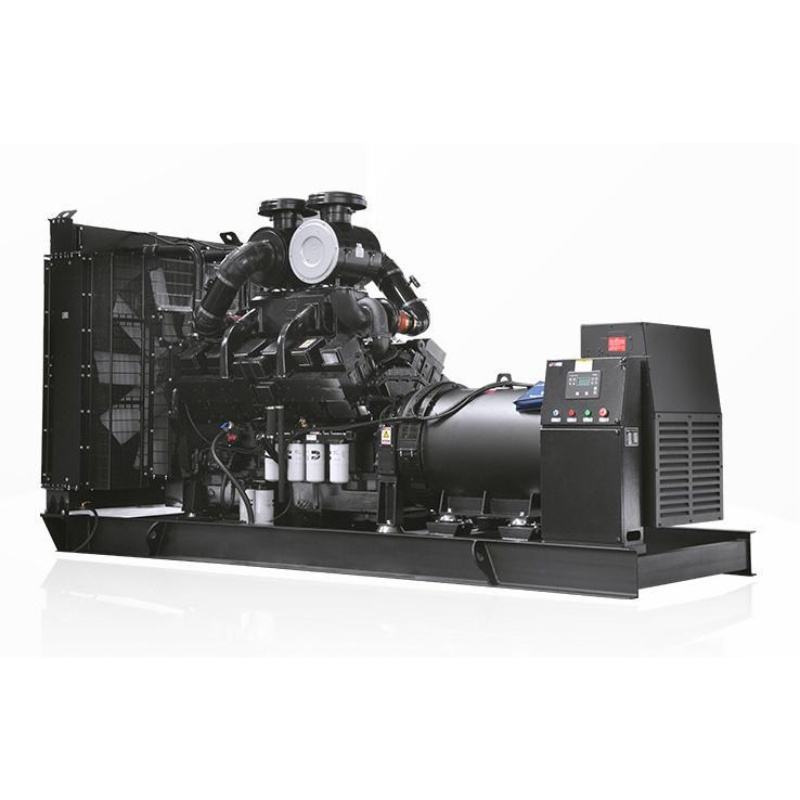
For a site team the practical question is not the physics but the number on the data sheet. The engine maker publishes a derate curve that crosses altitude on one axis and temperature on the other. Reading that curve correctly is the difference between a set that carries the load and a set that trips the breaker on the first hot week. Our diesel generator maintenance checklist lists the readings the site engineer should log during commissioning, and those same readings feed the derate check at every major service.
What does ISO 3046 say about diesel generator derating altitude?
ISO 3046-1 defines how an engine maker has to publish the derate. The standard asks for a continuous power rating at reference conditions of 25°C, 100kPa and 30% relative humidity, and it asks for the correction factors that move the rating away from those conditions. The maker publishes a table or graph giving one factor for altitude and another for temperature, and the two multiply rather than add. A rating without those factors is not a complete data sheet, and the full text sits on the ISO 3046-1 page.
Typical correction factors for a turbocharged industrial engine are 2% per 100m above 1000m and 2% per 10°C above 25°C. A naturally aspirated engine derates faster, often 3% per 100m and 3% per 10°C, because no turbocharger recovers the air mass at low pressure. Tesla Power quotes the derated figure on every offer and keeps the underlying data sheet in the same envelope, so the buyer can check the assumption against the load list and the site survey without a follow-up email.
How do site altitude and ambient temperature change the curve?
Two numbers on a data sheet hide three site decisions. The altitude value is fixed once the foundation is poured, so it rarely changes after the survey. The ambient temperature is a range, and the range matters more than the average because the set must carry the load on the worst week of the year. A highland site in summer is not the same as the same site in winter, and the summer case sets the rating.
Humidity changes the air density as well, though the effect is smaller than altitude or temperature on its own. ISO 3046 fixes the reference at 30% relative humidity, and a very humid site can lose another 1% to 2% on top of the temperature line. A diesel for tropical sites faces the same humidity loss, and a buyer who skips that line ends up short by one derate step.
What does a highland sizing example look like in practice?
Take a site at 2000m altitude and a 30°C ambient day, and a generator set rated 500kVA at 25°C, 1000m. Apply the ISO 3046 correction factors: altitude factor for (2000 − 1000) ÷ 100 × 2% = 20% loss, temperature factor for (30 − 25) ÷ 10 × 2% = 1% loss. The combined factor = 0.80 × 0.99 ≈ 0.79. Derated output = 500kVA × 0.8 = 400kVA at 2000m, and the 0.8 power factor on the alternator nameplate gives 320kW of usable real power at the same conditions.
| Site altitude | Derated kVA at 25°C | Derated kVA at 40°C | Usable kW at 0.8 pf |
|---|---|---|---|
| 1000m | 500kVA | 440kVA | 400kW |
| 2000m | 400kVA | 330kVA | 320kW |
| 3000m | 300kVA | 275kVA | 240kW |
The arithmetic is straightforward, but the rounding hides the margin. A 500kVA set at 2000m and 30°C delivers 400kVA, not 500kVA, and that is the number the load list has to beat. If the site load is 330kVA continuous, the derated 400kVA set carries it with a 17% margin. If the load rises to 400kVA, the set sits exactly at rating with no spare, and any further loss on a hot afternoon trips the breaker. Yangzhou Tesla Power runs the same arithmetic on every export offer, and a diesel generator for export projects leaves the derated figure stamped on the data sheet, not the reference figure from the catalogue. The note on how the AVR holds voltage under load covers the excitation loop that has to deliver that derated figure on site.
How does ambient derate stack on top of altitude derate?
The two derates multiply rather than add. A 20% altitude loss and a 20% temperature loss compound to a 36% total loss, not 40%, because each factor applies to the surviving fraction of the rating. The compounding bites at the edges, where a site that looks borderline on altitude alone becomes clearly short once the summer temperature is added in.
A practical guard is to read the derate at the hottest expected ambient, not the annual average that hides the hot week. A site averaging 22°C may still see 38°C for a working week, and that 38°C is the number the calculation must take. The product page for a typical 100kVA export set lists the derate at 25°C and at 40°C so the buyer can check the compound factor without waiting for a revised offer from Tesla Power.
What derate allowances do buyers typically confirm before they order?
A clean purchase order states the site altitude, the design ambient temperature, the relative humidity, and the load profile. Those four numbers are the inputs to the derate, and without them the seller must guess. A guess usually defaults to 25°C and sea level, which suits the factory and wrongs the site, so the offer should quote the derated kVA at the four declared conditions.
The second confirmation is the duty class. A standby set runs a few hours a month and can be derated less aggressively than a prime set that runs daily. ISO 8528-1 defines the duty classes, and the data sheet states which class the published rating belongs to. Confirm the duty class before the derate, and keep the data sheet in the handover folder for the notified body to read. Tesla Power quotes both duty classes on every export offer, and the 500kVA silent diesel generator set is offered in both so the buyer can compare them directly.
How do you document the derate for a conformity file?
A diesel generator derating manufacturer files the derate calculation for an EU or US project in the technical file, with the data sheet, the site conditions and the arithmetic. The file does not need to be long. One page is enough, with the rated kVA at reference conditions, the two correction factors, the multiplied result, and the data sheet reference. Conformity assessment for the eu market under the Machinery Regulation expects to see the derated figure, not the reference figure, when the set is destined for a non-reference site, and the technical file is the document the notified body reads first.
The site engineer keeps a copy of the same derate in the project handover pack. The diesel generator CE marking requirements for the European market do not override the ISO 3046 derate, and the two documents sit side by side in the technical file. Tesla Power Equipment builds every export set to this sequence, and Chinese diesel generator manufacturers follow the same discipline so the data sheet page is the evidence, the conformity declaration is the formal claim, and the site handover is the operating record. Our engineering help notes list the data sheet fields a buyer should expect, so a missing field is a flag to ask the seller rather than a surprise at commissioning.
Where does altitude derating sit next to NFPA 110 and ISO 8528-1?
NFPA 110 covers the emergency power supply system for life-safety loads in the US, and it sets the start time (10 seconds for a Type 10, Class X set) and the runtime (2 hours at rated load). The standard does not set the derate, and it assumes the derate has already been applied. A set that delivers 400kVA at 2000m still has to deliver those 400kVA within 10 seconds and hold them for 2 hours. NFPA 110 and ISO 8528-1 are public documents, and the data sheet sits in the offer envelope between them.
The three standards layer cleanly once they are read against the same data sheet. ISO 3046 gives the derate, ISO 8528-1 names the rating class, and NFPA 110 sets the response time where it applies. A buyer who reads all three gets a consistent picture; a buyer who reads only one may order a set that meets the start time but cannot carry the load. Read about our factory to see the data sheet and the conformity file Tesla Power issues with every export set, and contact our engineering team for a derate calculation against a specific site.
Frequently asked questions about altitude derating
Yes. A continuous or prime duty set derates further than a standby set on the same engine, because the maker assumes the engine runs for long periods and applies a larger thermal margin. A 500kVA standby set may derate to 400kVA at 2000m, while the same set on prime duty derates to about 330kVA at the same altitude. Read the duty class on the data sheet before the derate line, and confirm the duty with the seller in writing.
Below sea level the air is denser and the engine makes a little more power, but most data sheets cap the rating at the reference figure rather than publish a gain. A hot valley behaves like a high-altitude site: the air is hot, the density is low, and the derate applies. The correction factor keeps the same shape, but read it off the temperature line at the higher ambient, and add the altitude of the valley floor even if it is only a few hundred metres above sea level.
No. A turbocharger pushes more air at the same pressure, but the air is still thinner at altitude, so the mass flow is lower than at sea level. The turbocharger reduces the slope of the derate, about 2% per 100m instead of 3%, but it does not remove the loss. The data sheet states the turbocharged curve separately from the naturally aspirated curve, and the two are not interchangeable on a highland site.
Re-check the derate whenever the site conditions change, such as a new building, a new ventilation system, or a different fuel, and at every major service. The data sheet does not change, but the site around the set may. A 5°C rise in room temperature from a blocked louvre has the same effect on the derate as a 200m rise in altitude, and the site log will show it before the set does.
Yes. The derate acts on the engine output, so both kVA and kW fall by the same percentage. State the power factor on the enquiry, because the relationship between kVA and kW is the power factor, and the derate does not change that factor. A 500kVA set at 0.8 power factor is 400kW at reference, and at 0.8 power factor at 2000m it is 320kW after a 20% derate.
Ask for the data sheet, the derate curve, the reference conditions, the duty class, and the conformity file. Those five documents let you reproduce the arithmetic without a follow-up email. A missing document is a flag to ask the seller to fill the gap, not a reason to drop the requirement, and the same five documents travel with the set to site.
Yes, in two ways. Better ventilation lowers the room temperature, which reduces the temperature derate, so a room held at 30°C instead of 40°C keeps the set on a better derate line. Sound-attenuated enclosures trap more heat, so a silenced set often derates further than an open-frame set on the same site. The derate calculation must use the room temperature, not the outdoor temperature, and Tesla Power project notes cover highland installations where a room redesign made the difference.