
Genset starting current is the figure a motor draws in its first second, and it decides how much frame the site needs. Read it from the nameplate rather than the brochure, and Tesla Power will size the frame against that step and return a quotation that names the dip.
- Read the step from the largest motor, because the voltage dip a motor start causes is what the frame has to survive.
- Multiply the running current by the starting factor for the method, which is 6.5 for a direct on line start.
- Compare that figure with the alternator subtransient reactance before the frame is fixed.
- Ask for the permitted dip in writing, because a frame chosen without it is chosen twice.
What does genset starting current decide before a frame is chosen?
It decides four things on one page: the alternator frame, the breaker setting, the cable size and the starting method. A site that reads only the running load answers the first of those and guesses the other three. The step is a short event, and it is the event that pulls the voltage down at the far end of a feeder.
The reason is that a motor at rest looks like a short circuit through a small resistance. Its power factor during the start sits near 0.35, so the current is almost all reactive and the alternator carries it without much real power to show for it. The engine barely notices the step, and the alternator carries the whole of it. That split is why a frame chosen on engine kW alone meets a dip it was not built for.
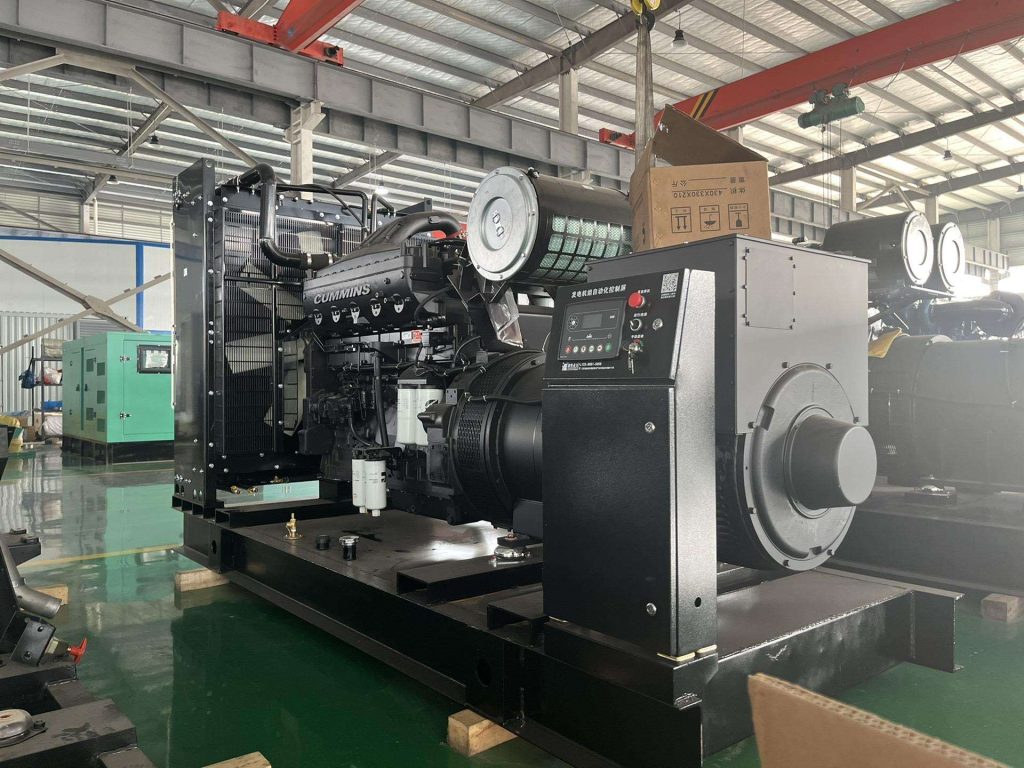
How is starting current calculated from a motor nameplate?
Start with the shaft output, convert it to input kVA, then multiply by the starting factor. An 80kW motor at 0.94 efficiency and 0.85 power factor draws 80 ÷ (0.94 × 0.85) = 100kVA while running. At 400 V three phase that is 100,000 ÷ (1.732 × 400) = 144 A. A direct on line start at 6.5 times running current gives 144 × 6.5 = 936 A during the step.
Two of those steps catch buyers out. The efficiency and the power factor belong to the running condition, and both improve during a start, which is why the starting kVA is not simply 6.5 times the running kVA. The other is that the nameplate kW describes the shaft, so a motor quoted at 80kW draws more than that from the board. Tesla Power asks for the motor schedule rather than a total, because the largest single motor sets the answer.
| Nameplate row | Figure used here | What it changes |
|---|---|---|
| Shaft output | 80kW | Sets the running load the site carries |
| Efficiency at full load | 0.94 | Raises the input above the shaft figure |
| Power factor, running | 0.85 | Converts kW to kVA at the board |
| Starting factor, DOL | 6.5 times running current | Sets the current during the step |
| Starting power factor | about 0.35 | Explains why the dip is mostly voltage |
Worked example: an 80kW motor on a 400kVA frame
Genset starting current for an 80kW motor on a 400kVA frame works out in four lines. The frame at 400 V carries a rated current of 400,000 ÷ (1.732 × 400) = 577 A, and the 936 A step is 1.62 times that figure. With an alternator subtransient reactance of 0.12 per unit, the dip is 1.62 × 0.12 = 19.4%. That sits at the edge of what a G2 site accepts.
Move to a 625kVA frame and the same step reads differently. Rated current rises to 902 A, the step is 1.04 times rating, and the dip falls to 1.04 × 0.12 = 12.4%. The frame costs more than the 400kVA set and it holds the bus through the start. Tesla Power Equipment prices that difference as an alternator frame rather than as an upgrade, so the two lines can be compared on one quotation.
Which starting method changes the figure?
Four methods cover most export sites, and each one cuts the step by a known share. Direct on line leaves it whole. A star delta starter cuts the current to a third, so the 936 A step becomes 312 A. A soft starter set to three times running current gives 432 A. A variable speed drive holds the current near the running value and removes the step altogether.
The method belongs in the tender rather than in the commissioning plan, because it changes the frame the buyer pays for. On the 400kVA frame above, a star delta start gives 0.54 × 0.12 = 6.5% dip, which the frame carries with room to spare. A soft starter gives 0.75 × 0.12 = 9.0%. Either method keeps the smaller frame, and the motor limits behind both come from the IEC motor standards that set the starting class.
- Direct on line for a motor the frame was sized on.
- Star delta where the motor drives a load that can start unloaded.
- Soft starter where the driven load has to come up under torque.
- Variable speed drive where the process needs speed control as well.
What does ISO 8528-5 allow for a voltage dip?
The standard sets the transient limits by performance class, and the class belongs in the enquiry. A G1 set may dip 25% on a step, G2 allows 20%, G3 allows 15% and G4 allows 10%. The class describes the set rather than the site, so a site that cannot tolerate more than 10% needs a G4 machine or a smaller step. The ISO 8528-5 performance classes name the recovery time as well as the depth.
Recovery matters as much as depth on a site with drives. A dip to 15% that clears in 0.4 seconds may be harmless, and the same dip held for two seconds trips every contactor on the bus. The class fixes both figures, so a buyer who names only the depth has answered half the question. Tesla Power states the class, the dip and the recovery time on the test sheet for each frame, so the three can be read together.
How does a load list hide a second start?
A load list totals the running figures and says nothing about sequence, and the sequence is where the second start hides. Two 80kW motors that start together make one step of 1,872 A rather than two of 936 A. A chiller that restarts after a transfer joins the load already on the bus, so its step lands on top of the running figure rather than on an empty one.
Reading the list for that pattern is a matter of asking three questions about each large motor. Does it start alone, does it restart automatically after a transfer, and how long does it take to come up? The answers turn a flat total into a sequence, and the sequence is what the frame carries. A genset for a site that restarts eight chillers needs a frame chosen on the group rather than on the largest unit.
Which figures belong on the enquiry?
Five figures let a supplier answer without a second exchange, and a buyer who sends them gets a comparable reply. The largest motor output in kW, its starting method, its starting factor, the site voltage and the permitted dip are the five. The site ambient belongs beside them, because genset starting in a hot room carries a lower figure before the step even arrives, and Chinese genset suppliers often leave that row off the reply.
Ask for the dip as a percentage at the terminals rather than as a statement that the set will start the motor. A reply written as a promise cannot be checked at commissioning, and one written as a figure can. The step load acceptance notes set out the same five rows as a schedule, and Tesla Power completes that schedule before the price is written rather than after.
- Largest motor output, starting method and starting factor.
- Site voltage, frequency and the permitted dip at the terminals.
- Ambient at the set and the altitude of the site.
What goes wrong at commissioning?
The common failure is a set that starts the motor in the yard and trips the site on the first transfer. The yard test runs the motor alone, and the site runs it beside a building load that is already drawing current. The step then lands on a bus that is already loaded, and the dip is deeper than the calculation predicted.
The second failure is a breaker set too tight for the step. An overcurrent relay set at the running current sees a 936 A step as a fault and trips in the first cycle. The setting belongs above the step and below the cable limit, which is a narrow band on a frame chosen tightly. Most genset manufacturers publish that band as a curve, and Tesla Power prints it beside the serial number. The breaker sizing notes give the band for each frame, and the range of frames we build shows where each rating sits.
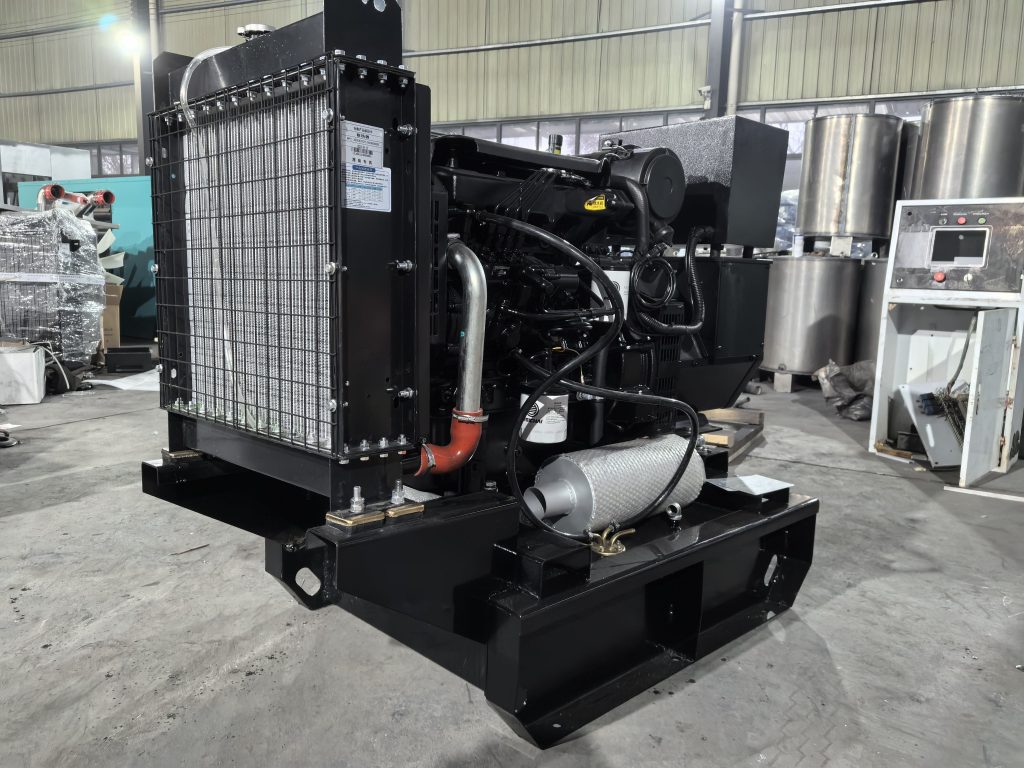
How is the step measured before shipment?
A load bank applies the step in blocks, and a recording analyser captures the dip at the terminals. The test applies 25%, 50%, 75% and full rating in turn, then applies the calculated motor step on top of a steady load. The trace shows the depth and the recovery, and both are compared with the class named in the tender.
A set that passes the block steps and fails the motor step is a set with too little alternator for the site. The fix is a larger frame or a starter, and neither can be fitted at the quayside. Tesla Power records the step on the same sheet as the serial number, so the figure that was promised and the figure that was measured sit on one page. That page is what a warranty question is read against.
Frequently asked questions about genset starting current
They are close but not identical. Locked rotor current is measured with the shaft held still at rated voltage. Starting current is what the motor actually draws in the first cycles, and it falls as the motor speeds up, so the figure used for sizing is the locked rotor value.
Most motors reach running speed within two to eight seconds, and the current falls through that window. A high inertia load such as a fan or a centrifuge holds the step longer, and a long step heats the alternator more than a short one at the same depth.
It solves the depth and it costs money on every frame above the need. A starter often solves the same dip for less, and the two should be priced side by side before the order. A frame bought for one motor start is a frame paid for over the life of the site.
They can when the frame is chosen on the combined step rather than on either motor alone. Two 80kW motors starting together read as 1,872 A for a few seconds, which is a step most frames at this size cannot hold without a starter.
The cable adds impedance between the alternator and the motor, and the current through it drops more voltage at the far end. A feeder sized for the running current can show a dip twice the terminal figure at the motor, which is why the cable run belongs in the calculation.
Ask for the dip at the terminals, the class it meets, the recovery time and the frame the reply is based on. Four lines on one page turn the answer into something a commissioning engineer can measure, and a reply without them cannot be checked.
Write the largest motor, its starting method and the permitted dip on one page, and send it to our export desk. Yangzhou Tesla Power returns the frame, the alternator reactance and the expected dip as three lines on the quotation. The genset starting current CE marking requirements sit in the technical file rather than on the plate, and conformity assessment for the assembly follows the same route as for the standard frame, so one file answers both questions.