
A diesel vs natural gas generator comparison turns on fuel delivery rather than on the engine, because a gas set needs a pipeline or a tanker and a diesel set needs a tank. Compare the runtime, the storage and the service interval as three lines, and Tesla Power quotes both options on the same load.
- Count the hours the site runs a year before comparing the two fuels.
- Check whether a gas line reaches the site, because a generator without fuel is a shed.
- Compare the service interval, which favours diesel on a site without a technician.
- Read the offer against the 200kW set on the WP10 engine before the fuel decision is closed.
What decides a diesel vs natural gas generator choice?
Four figures decide it, and the engine is the last of them. The hours a year, the fuel price at the site, the cost of bringing the fuel there, and the service support within reach are the four. A site that runs 200 hours a year gains little from a gas set, and a site that runs 6,000 hours a year gains a great deal.
The fuel chain is the figure buyers underestimate. Diesel arrives by truck to a tank the site already has, while gas arrives by pipeline, by CNG cascade or by LNG tanker, and each of those three needs equipment the site may not own. A gas set without a gas supply is a capital cost with no output, and the supply question comes before the engine question.
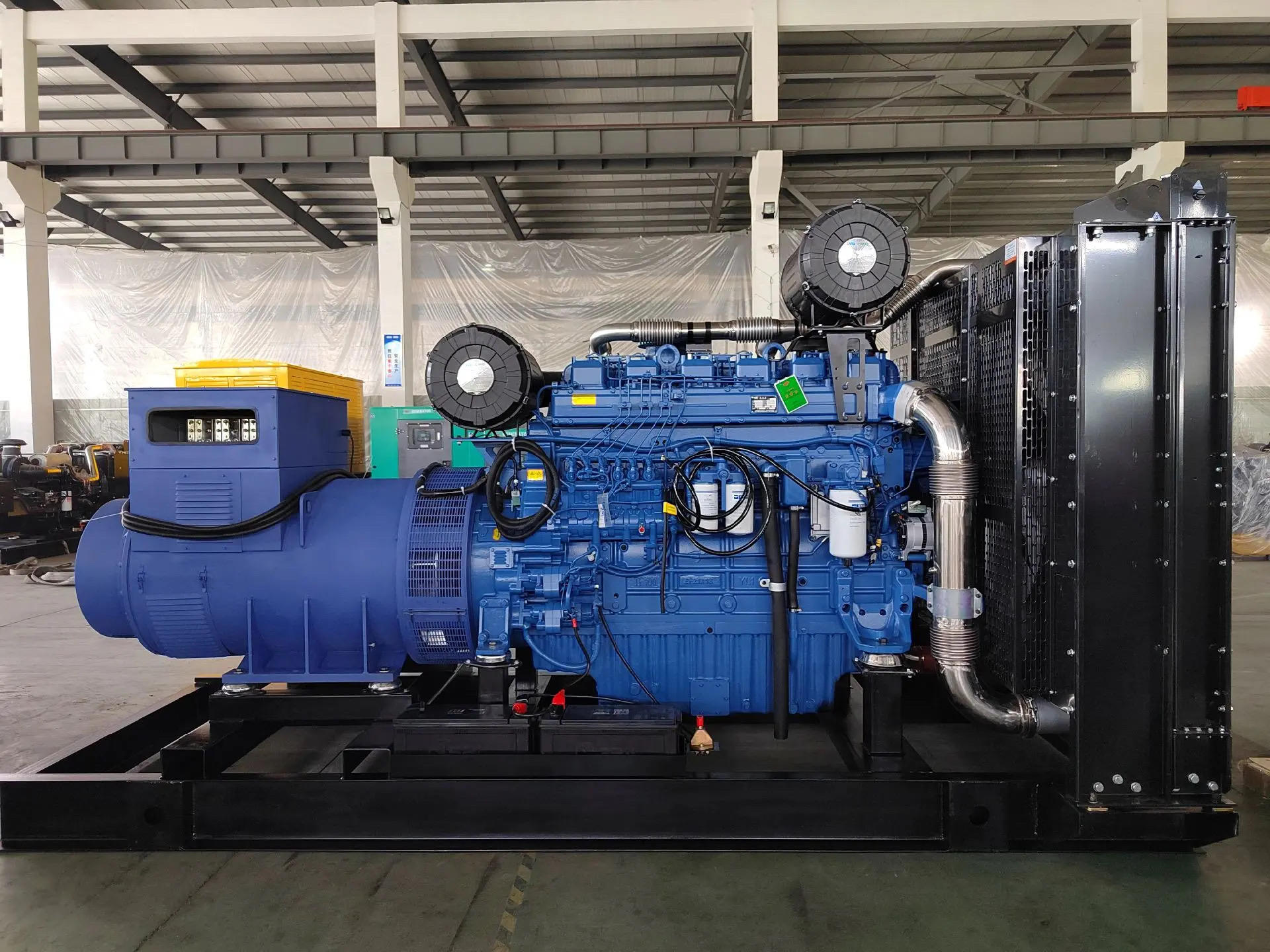
Is a gas set cheaper to run?
It is cheaper per kWh in most markets where the pipeline reaches the site, and it is dearer where the gas arrives by cascade. The gap between the two fuels moves with the local price rather than with the machine, so the comparison has to be run on the site rather than on a chart.
How does the runtime change the answer?
Runtime turns the fuel price into a yearly figure, and the yearly figure decides the choice. A standby site that runs 100 hours a year spends little on either fuel, so the capital cost dominates and diesel wins on simplicity. A prime site that runs 6,000 hours a year spends more on fuel than on the set, so a 20% fuel saving pays for a great deal of equipment.
The arithmetic is easy to run, and Tesla Power runs it on the load profile before it quotes either fuel. At 200kW and 0.21 L/kWh the diesel set burns 42 L/h, so 6,000 hours a year takes 252,000 L, and the gas set at the same output takes the energy equivalent. The The total cost of ownership notes carry the same calculation across fuel, service and capital for both options.
- Hours a year, taken from the load profile.
- Fuel price delivered to the site, not at the refinery gate.
- Capital cost of the fuel equipment, which differs by supply type.
Which fuel supply suits an off grid site?
Three supply types reach an off grid site, and each one carries a different cost and risk. A pipeline is the cheapest per unit and the least flexible, because it exists or it does not. A CNG cascade arrives by truck in steel cylinders and suits a site within a day of a filling station. An LNG tanker carries more energy per load and needs a cryogenic tank the site has to own and staff.
The storage figure is where diesel wins on most remote sites. A 1,500 L tank holds about 8.9 hours at 200kW, needs no pressure vessel and no specialist operator, and can be filled by any truck with a pump. A gas supply with the same energy needs a cascade of cylinders at 200 bar or a cryogenic tank at −162 °C, and both need an operator who has been trained.
| Fuel | Storage at the site | Refill | Operator skill |
|---|---|---|---|
| Diesel | Atmospheric tank, bunded | Truck with a pump | Basic |
| CNG | Steel cylinders at 200 bar | Truck with a cascade | Trained |
| LNG | Cryogenic tank at −162 °C | Tanker with a pump | Certified |
Worked example: a mine that runs 5,000 hours a year
A mine drew 160kW for 5,000 hours a year and compared the two fuels on the delivered price. Diesel delivered cost 1.05 per litre, so 160kW × 0.21 L/kWh = 33.6 L/h, and 5,000 h × 33.6 L/h = 168,000 L, which is 176,400 per year. Gas delivered cost the equivalent of 0.72 per litre of diesel, so the same energy came to 120,960, a saving of 55,440 a year.
The saving paid for the gas equipment in under three years, and the mine still chose diesel. The reason was the refill: the CNG cascade truck could reach the site twice a week and the mine needed a supply every second day at full load, so the storage would have doubled the capital. Tesla Power priced the storage as a line rather than as an assumption, which is what turned the decision.
Which service interval favours diesel?
A diesel set runs 250 to 500 hours between oil changes, and the work needs a mechanic with a filter and a sample bottle. A gas set runs longer between changes because the fuel burns cleaner, and it needs a technician who understands the ignition system and the gas train. On a site without a trained technician, the simpler engine wins even when the fuel costs more.
The parts chain matters as much as the interval. A diesel filter is on a shelf in most towns, while a gas regulator or an ignition module may take three weeks to reach a camp. A site that keeps a spares kit can run either, and a site that does not should choose the engine whose parts arrive fastest. Tesla Power Equipment lists the parts held at the regional warehouse beside the offer.
Does a gas set need a different enclosure?
It does, because the gas train needs ventilation at the top of the enclosure and the detector sits above the engine. A diesel canopy with a gas set inside is a canopy that fails the gas code on the first inspection, so the enclosure is specified with the fuel rather than after it.
How does the emission rule differ between the fuels?
Both fuels fall under stationary engine rules, and the gas engine usually meets a tighter NOx figure without after-treatment. A diesel engine at the same tier carries a particle filter and a control module, which adds cost and a service item. The rule that applies is set by the destination market, and the US rule for stationary engines is set out in EPA stationary engine rules. In Europe the same duty falls under the EU Stage V emission scope, and the tier on the plate follows the market rather than the engine.
The tier also decides the fuel specification, and a gas set is more sensitive to it than a diesel set. The conformity assessment for the destination market follows from that tier rather than from the fuel. A gas supply with a low methane number derates the engine and can knock, so the site needs the analysis before the order rather than after. The gas analysis is asked for on every gas enquiry, and the derated figure comes back with the quote.
Which one starts better in cold weather?
Diesel starts on a battery, a starter and a heater, and the cold limit is the fuel rather than the engine, which is why Yangzhou Tesla Power keeps the winter grade beside the serial number. A gas set starts on a spark and needs the gas pressure at the mixer, and a cold morning affects the regulator before it affects the cylinder. Both need a block heater on a cold site, and the diesel set also needs a winter fuel grade.
A site that sees −20 °C should read the cold start clause rather than the ambient rating. A diesel set at that temperature needs a jacket heater and a battery charger, and a gas set needs a heated regulator and a supply line that does not condense. The altitude and temperature notes cover the derating side of the same question.
Which records settle a fuel comparison?
Three records settle it: the load profile, the delivered fuel price and the storage capacity at the site. A comparison without the three is a comparison of brochure figures, and the answer usually reverses when the storage is priced. Tesla Power writes all three into the enquiry form for that reason, and reads the hours a year before it reads the fuel price.
- Load profile with the hours a year.
- Delivered fuel price for both options.
- Storage and refill capacity at the site.
The fuel chain is priced as a line on the offer rather than as a note, because the storage is the item that reverses a comparison. Chinese diesel suppliers quote the engine and leave the fuel chain to the buyer, so the engineering notes on fuel planning are worth reading before either order. Most diesel manufacturers will quote both options on one enquiry, and the storage is priced beside the set rather than separately.
Frequently asked questions about fuel choice
It is in most markets with a pipeline, by 20% to 35% on the fuel alone. The saving shrinks once the storage and the operator cost are added, and on a remote site it can disappear altogether, so the comparison has to include both.
It can be replaced rather than converted in most cases, because the compression ratio, the ignition system and the head are different. A conversion kit exists for some engines and costs close to a new gas engine, which is why most sites replace the set.
Diesel, because the set runs few hours and the storage is already there. A standby gas set needs a supply that stays pressurised for months without use, and a pipeline that is idle is a pipeline that may be cut off in an emergency. Tesla Power quotes both fuels on one enquiry so the standby case can be read beside the prime one.
It lasts as long when the gas is clean and the ignition system is serviced. A gas engine runs cleaner oil but hotter valves, so the head work arrives earlier and the bottom end arrives later, and the two roughly balance over a decade.
It is quoted in cubic metres per hour rather than in litres, and the figure at 200kW is close to 48 m³/h on natural gas. Convert it to the diesel equivalent before comparing prices, because the two units are not interchangeable at the pump.
Diesel, usually by two to four weeks, because the gas train and the detector are bought against the order. A site that needs a set in a quarter should order diesel, and one that plans a year ahead can take either.
Count the hours, price the fuel delivered, then price the storage, and the comparison answers itself. Send the load profile and the fuel options to our export desk and Tesla Power will quote both on the same duty with the storage named as a line. We keep the analysis behind the recommendation, so the fuel decision is made on the site rather than on a chart.