
Generator transient response ISO 8528-5 fixes how far voltage and frequency may swing at a load step, and how fast both must recover. Tesla Power checks a set against three figures: the dip, the recovery time and the steady-state value. Compare those three with a supplier before the quote.
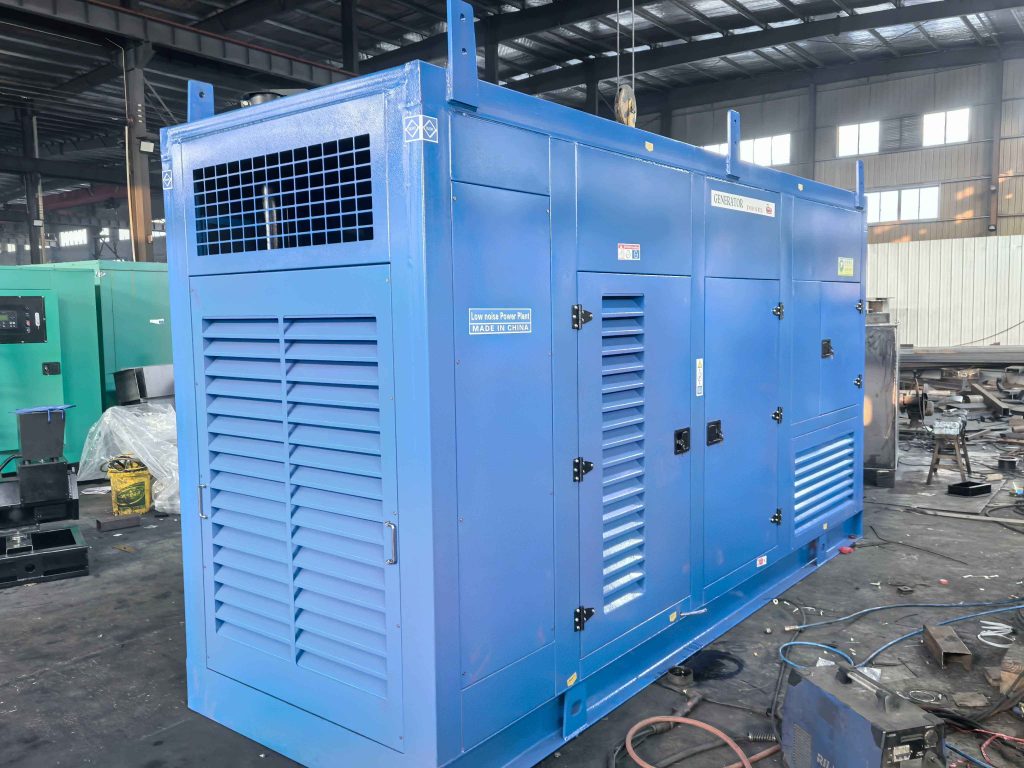
- Read the 500kVA silent set with ATS sheet first, because alternator reactance sets the depth of the dip.
- Record the step size and the power factor on the same line as the measured dip.
- Measure at the terminals, not at the far end of a long cable run.
- Agree the class (G1 to G4) in writing, because one frame can satisfy two different classes.
- Send the load profile with the enquiry so the class is matched to the duty.
What does generator transient response ISO 8528-5 measure?
The standard measures three things at the terminals: the transient deviation of voltage and frequency when the load changes, the time each takes to recover, and the steady-state deviation left behind. Each figure is tied to a stated load step, a stated power factor and a performance class. A dip figure without those three conditions cannot be checked against anything.
The test is a step, not a ramp. The set runs at a known load, the load is switched in one block, and the recorder captures the lowest excursion plus the time to return inside the band. A 25% step and a 100% step give different dips on the same machine, so an acceptance sheet has to name the step.
Tesla Power writes the step, the power factor and the class on the first line of an acceptance report. The order matters, because a dip that satisfies one class can fail the next class up on the identical frame.
Which figures move when a load step lands?
Voltage falls first and recovers within milliseconds to about one second on most frames. The drop comes from the internal impedance of the alternator and from the time the excitation system needs to raise field current. A brushless machine with a permanent magnet exciter lifts the field faster than a machine fed from the stator through a transformer, and the two curves look nothing alike on a recorder.
Frequency falls more slowly and recovers over several seconds. The engine has to accept fuel and build torque against its own rotating inertia, so the governor shapes the curve long after the alternator has returned to nominal. Tesla Power records both channels on one time base, because a diesel set can show a clean voltage trace while the frequency is still 2 Hz low half a second later.
How is a voltage dip calculated from alternator reactance?
A first estimate comes from the subtransient reactance. The depth of the dip depends on how large the step is against the rating, and on the reactance the alternator presents during the first few cycles after the switch closes. Alternator data sheets publish that reactance as a per-unit value, and it is the number worth asking for before a specification is fixed.
The approximation is dip = X''d x (step divided by rating) x 100, where X''d is the subtransient reactance in per unit. The arithmetic ignores magnetic saturation and the excitation ceiling, so a measured value usually lands a little below the calculated one. Treat the estimate as a screening figure, not as evidence.
- Take X''d from the alternator data sheet, not from a catalogue summary.
- Express the step as a fraction of the rating at the same power factor.
- Confirm the screening figure with a recorded step-load test.
The worked case is a 500kVA set at 0.8 power factor, so 500kVA x 0.8 = 400kW, with a subtransient reactance of 0.12 pu. A full-block step of 400kW on a 400kW rating gives 0.12 x 1.0 = 12% dip, which is 400 V x 0.12 = 48 V below a 400 V nominal, leaving 352 V at the terminals.
Tesla Power Equipment quotes X''d beside the rating on the prime rated diesel set range, because the two numbers only mean something together.
Which ISO 8528-5 performance class fits the load?
The class follows the load, not the price. G1 covers general purpose work where a wide voltage band is acceptable. G2 suits lighting, pumps and fans. G3 covers telecommunications and thyristor-controlled drives. G4 is written for data processing equipment that cannot tolerate a deep dip, so a generator for data centres is specified at G4 and not at G2.
Four questions decide the class in practice. The middle column of the table below is where most disputes start, because a buyer compares two offers without checking that both name the same class.
| Class | Loads it covers | What to confirm in the offer | Where sites get it wrong |
|---|---|---|---|
| G1 | General purpose, hand tools, resistive heating | Step size and power factor used for the figure | Class quoted, step left blank |
| G2 | Lighting, pumps, fans, conveyors | Dip at the terminals, not at the bus | Cable drop counted as generator dip |
| G3 | Telecom rectifiers, thyristor drives | Dip and recovery time as a pair | Recovery quoted without the band |
| G4 | Data processing, uninterruptible supply loads | Both channels on one recorded trace | Voltage-only evidence accepted |
Tesla Power asks for the class in the enquiry, not at the offer stage. A class named late changes the alternator and the excitation system, and often the frame as well. The questions that decide it are short, and they belong in the enquiry.
How does frequency response differ from voltage response?
Voltage is an electrical problem with an electrical answer. The automatic voltage regulator (AVR) raises field current, the terminal voltage climbs back, and the whole event can finish inside a second. Excitation ceiling and the speed of the sensing circuit set the recovery time, so a set with a slow regulator shows a second dip when the next step lands.
Frequency is a mechanical problem. The governor opens the fuel rack, the turbocharger has to spin up, and the engine has to accelerate its own inertia plus the load. Recovery therefore runs in seconds, and a set that accepts a block faster than the turbo can supply air will recover slowly and smoke while it does. The voltage regulation notes cover the electrical side; the ISO 8528-1 rating framework fixes the output the set must still deliver during the event.
What changes when two sets run in parallel?
Two sets share the step, so the dip per machine is smaller and the recovery is quicker. The trade is control: each governor now works against its partner, and the droop setting decides how the block divides. A pair set to zero droop pushes current back and forth, while 3% to 5% droop settles the split within seconds. That is why a generator in parallel operation is specified with its partner.
Phase angle matters before the breaker closes. At 50 Hz one cycle lasts 20 ms, so a 10 degree error adds up to about 0.55 ms and produces a current surge at the instant of closing. Synchronisers check voltage, frequency and phase together, and a manual close on lamps belongs in a commissioning exercise.
Yangzhou Tesla Power asks for the intended load split before it releases a parallel package, because the answer sets the droop, the reverse power relay and the busbar rating.
Which protection settings trip during a transient?
Protection has to ride through the transient it was fitted to survive. An instantaneous overcurrent relay set at the running current will trip on a legitimate motor start, and the site then blames the set. The usual answer is a short time delay, a higher pickup, or both, agreed against the step the set was sold to carry.
Undervoltage protection needs the same treatment. A relay set above the expected dip will drop the load it was meant to protect, and on a site with a soft start the first block load often does exactly that. Set the pickup below the calculated dip, add a delay longer than the recovery time, and record both figures beside the test result. The standby power requirements list sets out the full protection schedule.
- Set overcurrent pickup above the largest single step, then delay it past the recovery time.
- Set undervoltage pickup below the calculated dip, with a delay longer than the recovery.
- Add reverse power protection on any set running in parallel with another.
- Test the settings on the same day as the step-load test, not months later.
How is transient response proven at commissioning?
Commissioning proves the figures with a recorded step, not with a visual check of a lamp. The set is loaded to a stated point, the block is switched, and a recorder logs voltage, current and frequency against time. Both the excursion and the recovery are read from that trace, and the class limit sits beside them.
What does the step-load test record?
The record holds the pre-step load, the step size, the lowest voltage, the recovery time in seconds, and the steady-state value after the transient. It also holds the power factor at the moment of the step, because a reactive load deepens the dip. Tesla Power Equipment keeps the trace with the handover file, since a later dispute is settled by that file rather than by memory.
Which instrument captures the dip?
A power quality analyser with a sampling interval short enough to see the first cycles, or a dedicated transient recorder, is the right instrument. A multimeter with a one-second update cannot see a dip that lasts 200 ms, and a panel meter smoothed for readability hides it. Ask for the sampling interval on the test sheet, and check that our acceptance template records it.
The test follows the sequence an emergency power standard expects for a witnessed run, so the NFPA 110 emergency power rules can serve as the review date. Documentation for conformity assessment for the export market then cites that same trace.
Which site conditions change the transient figures?
Altitude, ambient temperature and fuel quality all move the figures without changing the label. A set derated for a hot site has less margin for a step, and an engine running on a lower cetane fuel accelerates more slowly. The dip deepens when the excitation system is already near its ceiling because the alternator is hot. The engineering notes carry the derating arithmetic for that case.
Cable impedance changes what the load sees, which is a different question from what the set delivers. A long run to a remote panel adds impedance that deepens the dip at the load while the terminal voltage looks healthy. Tesla Power measures at the terminals for acceptance and checks the load end for design.
What should an enquiry state about transient performance?
Send four things with the enquiry: the largest single step in kW, the power factor at that step, the class the site needs, and the load types behind it. Those four answers let the frame, the alternator and the excitation system be chosen together, instead of being fitted to a steady-state rating alone. A load list with the starting order on it settles most of the questions before the offer.
A useful reply repeats the four answers and puts a figure beside each one. Dip at the terminals, recovery time, steady-state deviation and the class should appear on the first page of the offer, and the step-load test should appear in the scope. Any generator manufacturer can write the same four lines, so the comparison becomes a comparison of figures rather than of adjectives.
- Name the largest motor or block that starts as one step.
- State the power factor at that step, because reactive load deepens the dip.
- Ask for the class and the step used to quote it.
- Request the test scope, not only the steady-state rating.
- Send the load list to the engineering desk for a class check before the order.
Tesla Power answers a comparison line by line, and asks the same four questions of every site. A generator for hospital loads follows the tolerance the medical equipment states, not a general rule. Chinese generator suppliers who quote a class without the step are quoting a number nobody can verify.
Which records keep the figures defensible?
One sheet per set carries the whole case: class, step size, power factor, measured dip, recovery time and the instrument used. Add the date and the ambient temperature, and the sheet answers a warranty question years later. Sites that record only a pass or fail lose the evidence that would settle a dispute.
Trends matter as much as single readings. A dip that grows from one annual test to the next points to a weakening exciter or a dirty slip ring assembly, and a recovery time that stretches points to a governor or fuel issue. Read the two together. The build notes on current frames show the columns used on the factory test sheet.
Frequently asked questions about transient response ISO 8528-5
A load step is a block of load switched on or off in one operation, rather than ramped in gradually. It is described by its size against the rating and by the power factor at the instant it is applied. A quarter step and a full step produce very different dips on the same machine.
Recovery is usually complete well inside a second on a set with a fast excitation system, and the class limit states the time allowed. Read the figure with the recovery band beside it, because a trace that returns to within 5% of nominal has recovered even if the last fraction of a volt takes longer. Ask the supplier for the band, not just the time.
Because frequency is set by engine speed, and the engine has to accelerate its own inertia plus the connected load. Voltage is corrected electrically by the exciter within a few cycles, while speed needs fuel, air and torque. A turbocharged engine adds the time the turbo needs to spin up, which is why the frequency trace lags the voltage trace.
A larger frame usually reduces the dip because the step is a smaller fraction of its rating, but the alternator reactance decides how much. Two frames of the same rating can differ, so compare X''d as well as kVA. A set oversized for a steady load can still show a poor dip if its reactance is high and its exciter is slow.
Data processing and life safety loads usually call for G3 or G4, with the class written into the specification and repeated in the offer. The deciding factor is how much dip the load can tolerate and how long it can wait for recovery. Ask the equipment supplier for that tolerance before the generator class is fixed.
It can reduce the step a set sees, which often lowers the class needed, but it adds its own failure mode. A soft starter limits current during acceleration and then hands over to the bypass contactor, so the set sees a smaller first step and a second step at handover. Record both steps in the test plan.
The buyer, the load supplier and the generator manufacturer should agree the class before the order, because it changes the alternator and the excitation system. Send the largest step, the power factor and the load list in writing. Tesla Power answers that comparison line by line, and puts the step-load test in the scope so the figures can be proven at handover.