
Generator for mining site off grid work starts with the camp load list, not the frame size. Tesla Power sets out the duty rating, derating, fuel autonomy and parallel rules that decide whether a set carries the mine, and what to send with an enquiry so a supplier can quote against real figures.
- List every load in kW and mark the largest block that starts in one step; the containerised set for a remote camp page shows the frames built for that duty.
- Fix the duty class before the frame, because a prime and a standby rating are not interchangeable.
- Apply the altitude and ambient derate to the site, not to the sea level figure.
- Size fuel for the resupply interval rather than for one day of running.
- Ask for the test record that proves the set before the handover is signed.
Which loads does a generator for mining site off grid carry?
The load is a mixed industrial profile, and each part behaves differently at start. Crushers, conveyors and dewatering pumps pull several times their running current for a few seconds. Camp accommodation and the workshop draw a steady block. The control bus is small, but it cannot be dropped while a haul truck is on the ramp.
Start with the largest single block, not the total, because the step decides the frame more often than the running sum. A 150kW crusher started direct on line asks the alternator for roughly 2.5 times running current for several seconds. A variable frequency drive (VFD) or a soft starter on the same motor changes the step the set sees, so ask for the starting method of every motor above 40kW before the frame is priced and the offer is issued.
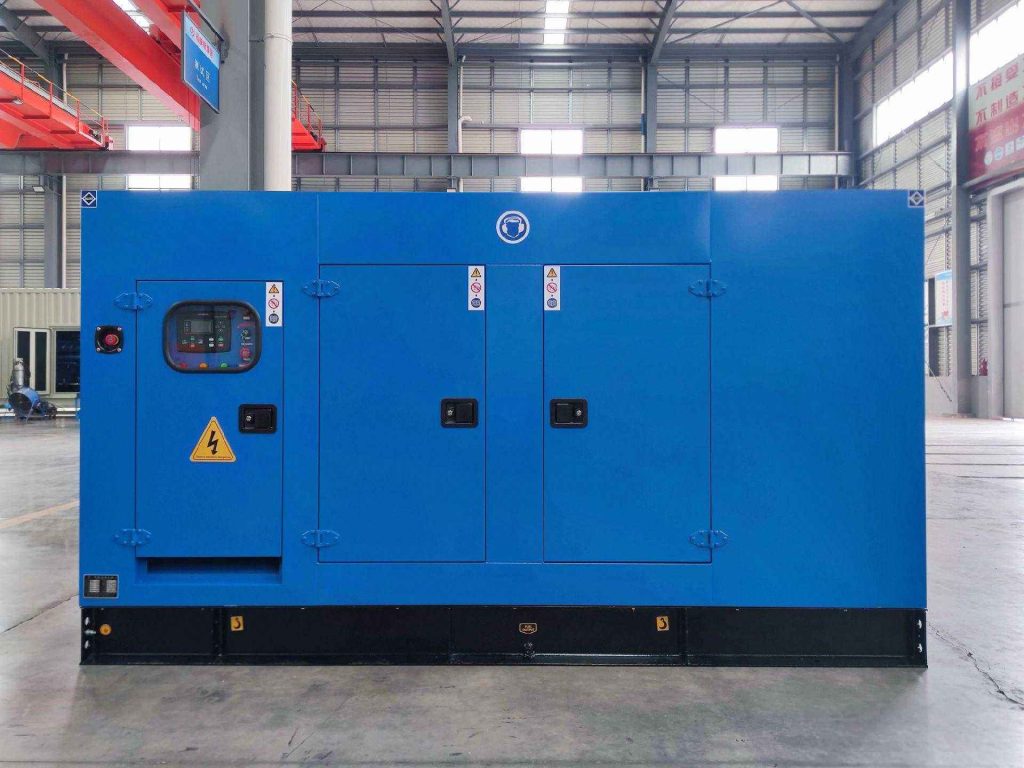
Dust and heat sit outside that electrical sum. A crusher house carries abrasive dust that closes radiator fins within weeks, and a pit floor in the afternoon runs hotter than the weather station records.
Which ISO 8528 duty rating fits an off grid mine?
The prime rating is the one that fits. The ISO 8528-1:2018 separates a continuous prime rating from an emergency standby rating, and a camp that treats the set as its only supply sits in the prime class, which allows a 10% overload for one hour in twelve. A generator for prime power duty carries that overload; a standby unit does not.
Check the running hours before the frame. A camp that runs round the clock reaches 8,760 hours in a year, and a set that idles at shift change still passes 6,000 hours. Read the rating column that matches those hours, then read the fuel curve at the same point. A standby rated set pushed into prime hours loses its warranty position and its injector life together, and the first symptom is usually oil consumption rather than a hard failure. That order matters more than the frame size.
- Ask for the rating class in writing, not the frame size alone.
- Compare the annual hours the camp expects with the hours the class allows.
- Read the fuel and derate curves at the same duty as the rating.
Two documents settle the question: the data sheet with the class printed on it, and the standard that defines that class. Tesla Power Equipment prints both on the offer. For a set bound for the United States, the EPA nonroad emission standards join the file as well.
How do you size the set from the camp load list?
Size from the running total, then check the largest step against the chosen frame. The running total sets the apparent power through the power factor, while the step check decides whether the alternator absorbs the block without tripping.
The camp below runs one pit and 120 people from one bus.
| Load group | Running power | Starting method | Step seen by the set |
|---|---|---|---|
| Primary crusher | 150kW | Direct on line | About 2.5 times running for 8 s |
| Conveyor drives | 80kW | VFD ramp | About 1.2 times running |
| Dewatering pumps | 50kW | Soft starter | About 2 times running |
| Camp and workshop | 40kW | Direct on line | About 3 times running for 3 s |
Adding the rows gives the running total the frame has to hold: 150kW + 80kW + 40kW + 50kW = 320kW. At the power factor of 0.8 stated in the site study, the apparent power is 320kW / 0.8 = 400kVA, so a 500kVA prime rated set carries the camp at about 80% of its rating and keeps room for the next haul truck.
Which load belongs on the first line of the list?
The largest motor that starts in one block, because it fixes the frame more often than the running total. Put its starting current, its starting method and the seconds it needs beside it, then repeat for every motor above 40kW.
Most generator manufacturers publish the derate curve and the fuel curve on the same sheet, and both are read at the site ambient. Compare that sheet with the 400kW prime rated set figures first.
How much does altitude and ambient heat cut the rating?
Both cut the rating, and the loss is published per model rather than as one universal percentage. A common order of magnitude on turbocharged frames is about 1% of output per 100 m above 1,000 m, and about 2% per 5 °C above 40 °C. The exact curve sits in the data sheet, and the offer should quote the derated figure.
Run the arithmetic on the worst hour rather than the annual average. A pit floor at 2,000 m with an afternoon ambient of 45 °C sits outside the reference conditions on both counts, and the two losses compound rather than cancel, because thinner air and hotter charge air both cut the mass of oxygen the engine can burn.
- Ask for the derate curve at the site altitude and ambient.
- Apply both losses at once, then add the starting margin.
- Recheck the fuel burn at the derated load.
Take a 500kVA frame with a published 1% per 100 m derate at 2,000 m: 500kVA x 0.10 = 50kVA of rating lost, so the same 400kW camp load moves to the 550kVA frame rather than the 500kVA unit chosen at sea level. Tesla Power quotes the derated figure beside the nameplate figure, so the two can be compared line by line.
The altitude derating figures on the export frames follow the same method, and the survey should record the ambient at the hottest hour of the year.
How much fuel autonomy does a remote camp need?
Autonomy is set by the resupply interval, not by the tank that fits the base frame. A camp that receives diesel twice a week needs 3.5 days of running fuel plus a reserve, and the bulk tank usually stands outside the bunded enclosure.
The figures below are indicative for a 500kVA prime rated frame and come from its fuel curve, so treat them as a planning step rather than a contract figure.
| Load against prime rating | Indicative fuel burn | What the figure assumes |
|---|---|---|
| 25% | 26 L/h | Light camp load, crusher stopped |
| 50% | 52 L/h | One shift, conveyors running |
| 75% | 78 L/h | Full pit, steady load |
| 100% | 104 L/h | Rated output, site ambient within limits |
Adding the day: a camp holding 75% of a 500kVA frame runs near 78 L/h, so 78 L/h x 24 h = 1,872 L per day. A 48-hour interval then needs 1,872 L x 2 = 3,744 L of usable volume, and the tank is ordered above that figure because the last 10% is not drawable at the suction point. Tesla Power sizes the tank and the bund together.
How is the tank size calculated from the burn rate?
Multiply the burn rate at the expected load by the hours between deliveries, then add the unusable heel and a reserve for a late truck. The fuel tank sizing arithmetic covers the rounding and the containment volume.
What changes when two sets run in parallel?
Two sets change the failure mode rather than the total capacity. A pair shares the block, so each machine sees a smaller step and the camp keeps power while one set is serviced. The trade is control: governors and protection are set for the pair.
Droop decides how the block divides. A pair set to zero droop trades current back and forth, while 3% to 5% droop settles the split within seconds. Reverse power protection is required on each machine.
Yangzhou Tesla Power asks for the intended split before releasing a parallel package, because the answer sets the droop and the relay settings. A generator in parallel operation is specified with its partner.
Which enclosure and logistics rules decide the delivery?
The enclosure and the shipping frame decide the delivery date more often than the engine does. A camp that needs a canopy for noise, dust and security also needs louvre area for the radiator, and a containerised set needs a route survey before the frame is booked, because the last road rather than the factory sets the limit.
A 20-foot container frame commonly carries a set up to 1,000kVA, and a 40-foot frame carries the larger sizes with the tank and switchgear inside the same box. The real constraint is usually the axle load on the final track rather than the frame itself, so the route survey belongs in the enquiry and not in the shipping week, and the lifting plan should name the crane capacity at the landing point as well, since that figure decides whether a mobile crane can be hired locally.
- Confirm the louvre area for the radiator before the canopy is closed.
- Survey the last road for width, axle load and turning circle.
- Decide whether the tank and the switchgear travel inside the container.
Dust and cold both change the build. A crusher house needs a pre-cleaner and a dust-tolerant radiator core, while a high-altitude pit needs the fuel system and the charge air set for the ambient. The engineering notes on site conditions list the options we specify for those cases.
What belongs in the RFQ for an off grid mine?
Send the site conditions, the load list and the interface points, and the supplier can quote without a round of questions. Four items do most of the work: the altitude and ambient, the largest starting block, the fuel autonomy in days, and the duty class.
- Site altitude, ambient at the hottest hour, and dust or humidity notes.
- The load list with the starting method beside every motor.
- Fuel autonomy in days and the resupply interval the road allows.
- Duty class, plus the hours the camp expects in a year.
- Whether the tank, the switchgear and the spares travel with the set.
A useful reply repeats those items and puts a figure beside each one. Chinese generator suppliers who answer with a frame size alone leave the derate open, and that gap surfaces at commissioning.
Tesla Power Equipment answers the same items line by line, then adds the enclosure, the tank and the spares list.
Which tests and records prove the set at handover?
Handover rests on a recorded step-load test, an insulation resistance reading and a protection setting sheet, and those three are the evidence a warranty claim will need later. A signed sheet without the trace behind it is worth very little.
The step-load test records the largest block the site expects, the voltage dip, the recovery time and the power factor at the moment of the step. The transient limits at the terminals explain how those figures are read.
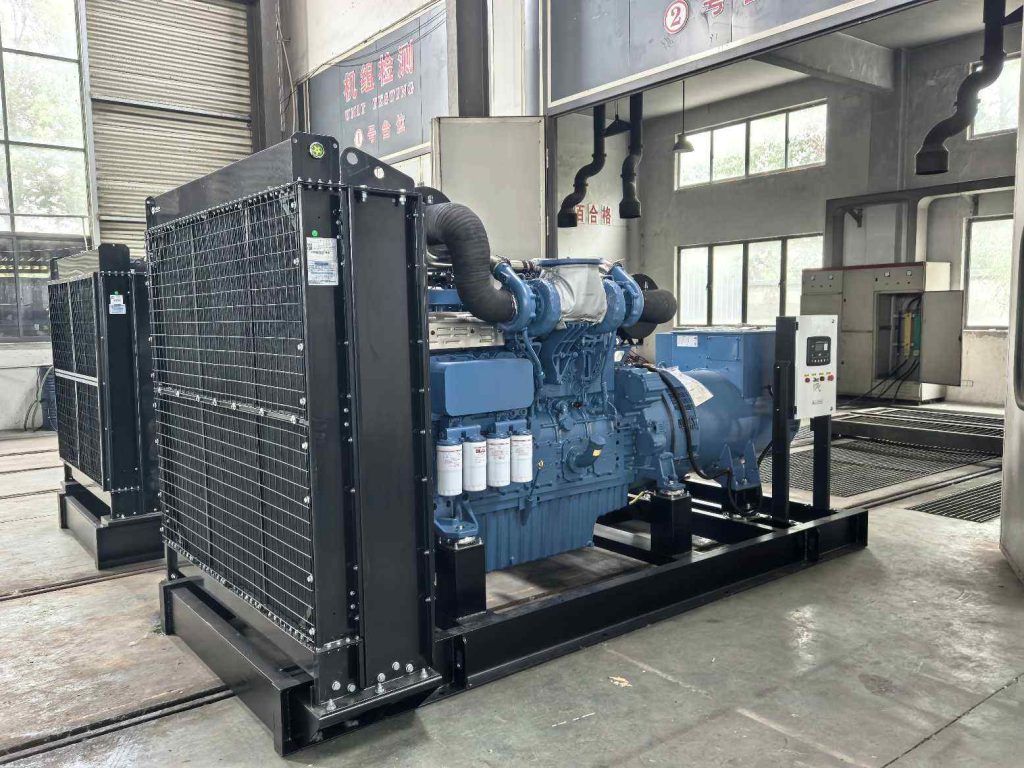
Tesla Power keeps the trace with the handover file, beside the insulation readings and the relay settings. The generator CE marking requirements sit in a separate file, and that file names the standards the set was checked against rather than the results it produced. The generator quality records for the site travel with the same pack.
Send the load list and the site conditions to our engineering desk before the frame is chosen, because those two documents decide the rating and the enclosure together.
Frequently asked questions about a generator for mining site off grid
Only for short outages. The standby class is written for limited annual hours and carries no overload allowance, so a camp that runs the set as its only supply sits outside that class on both counts. Move to a prime rating before the order.
Around 78 L/h at three quarters of the prime rating, and about 104 L/h at full output, read from the frame fuel curve at site ambient. The figure moves with the derate, so a high-altitude site burns more per kWh delivered.
Most data sheets start the derate above 1,000 m, and the slope is published per model. A pit at 2,000 m therefore sits outside the reference conditions by a margin worth pricing. Ask for the curve at the site ambient as well, because heat and altitude compound.
For continuity, yes; for fuel and service cost, usually no. A pair keeps the camp running during maintenance and cuts the step each machine sees, while doubling the fixed losses at part load. Choose the pair when an outage costs more than the extra fuel.
From the motor nameplate current and the starting method, not from the running kW. Direct on line starting draws roughly six to eight times nameplate current, a soft starter about two to three times, and a drive limits the ramp to a set value.
Four figures: the prime rating at site conditions, the largest step the set must absorb, the fuel autonomy in days, and the test record that will prove all three at handover. Tesla Power puts those four on the first page of the offer, so the comparison is a comparison of numbers.