
Genset frequency droop is the fall in speed between no load and full load, written as a share of the rated frequency. It decides how two sets share a block of load, so read the figure before the switchgear is ordered, and Tesla Power will return a quotation with the droop and the share stated.
- Ask for the droop setting in percent, because the load profile that drives the bus means nothing without it.
- Set every set on a parallel bus to the same droop, or the share drifts to the tighter one.
- Read the transient dip separately from the steady offset, because the two have different limits.
- Keep the test trace, since the share on site is read against the curve recorded in the works.
What does genset frequency droop set on a parallel bus?
A genset for a two set plant shares the block without any signal between the controllers. A set with a tighter droop reaches its share of the load at a higher frequency, so it carries more of the block. The controllers do not talk to each other, and the frequency of the bus is the only thing they have in common.
That is the whole principle behind the setting. On a single set the droop only decides how far the frequency falls when the load rises. On a bus with two or more sets, the same setting decides who carries what, and a mismatch of one percentage point between two frames is enough to push one of them past its rating. Droop is a load share device before it is a speed setting.
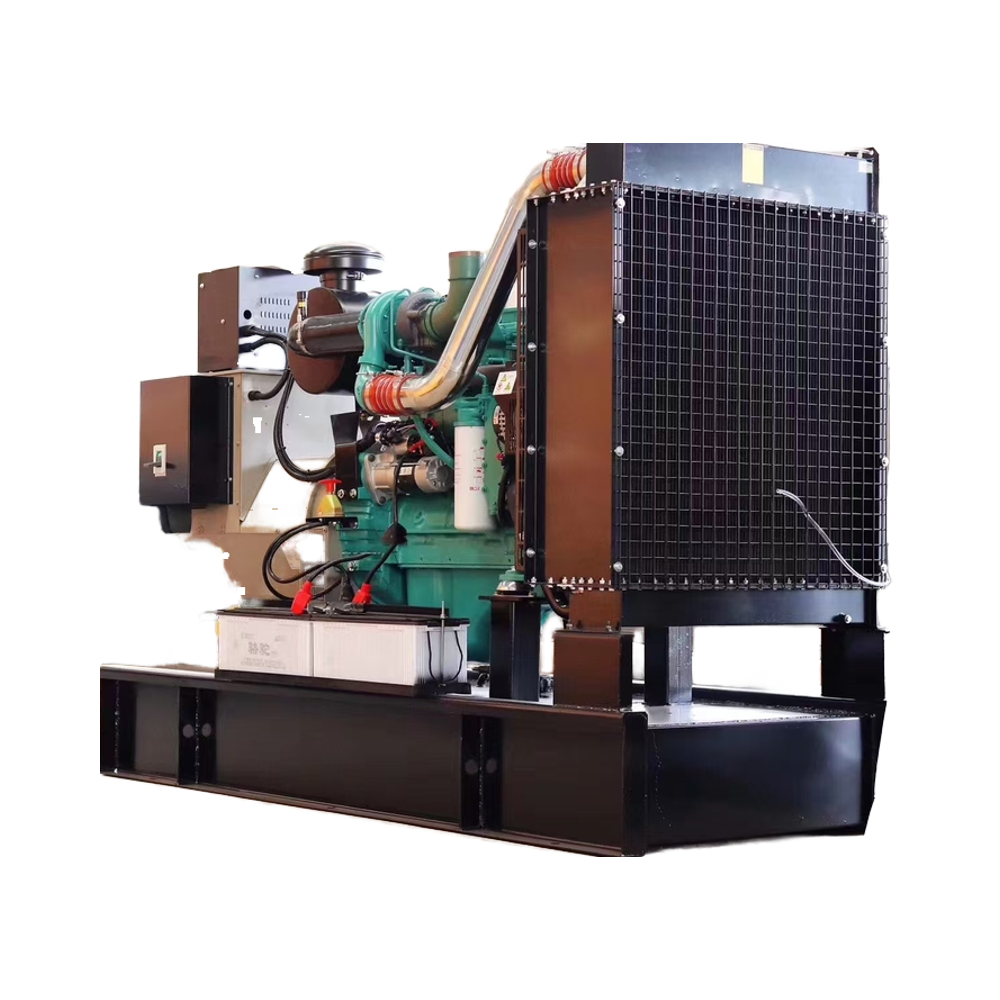
How is droop calculated from 50 Hz?
Multiply the rated frequency by the droop share and subtract it at full load. A 4% setting on a 50 Hz bus gives 50 × 0.04 = 2 Hz of fall, so the set runs at 48 Hz when it reaches its rating. A 3% setting gives 1.5 Hz and a 5% setting gives 2.5 Hz. The same arithmetic works on a 60 Hz bus, where 4% is 2.4 Hz.
The frequency is a speed in disguise. A four pole machine at 50 Hz turns at 1,500 rpm, and a 4% fall is 60 rpm at the shaft. That is why the setting sits on the governor rather than on the alternator, and why a genset in a plant room can change its share without anyone touching the switchboard. Tesla Power sets the droop on the test bed and records the speed at each load step.
| Droop setting | Fall at 50 Hz | Speed at full load |
|---|---|---|
| 0% (isochronous) | 0 Hz | 1,500 rpm, held |
| 3% | 1.5 Hz | 1,455 rpm |
| 4% | 2 Hz | 1,440 rpm |
| 5% | 2.5 Hz | 1,425 rpm |
Worked example: two 400kVA sets sharing 600kW
Take two 400kVA frames at 320kW each, sharing a block of 600kW, with one governor at 4% and the other at 5%. The share follows the inverse of the droop, so the tighter set takes 1.25 times the load of the looser one. That puts 56% on the first frame and 44% on the second, so the share is settled before the block size is even read.
The first frame then runs at 105% of its rating and the second at 82%. Nothing in the plant looks wrong, the bus holds 50 Hz minus the offset, and the overloaded set runs hot for as long as the block stays connected. Tesla Power Equipment sets both governors to the same droop on a paired order, and the test sheet records the share at 25%, 50% and 75% of the block.
Why must parallel sets carry the same droop?
Because the share is fixed by the difference between them, and a small difference grows into a large one. Two points of difference between a 3% and a 5% setting moves the share by a quarter of the block. The same two points on a 1,000kW block is 250kW that one frame carries and the other does not.
The setting also has to hold over time. A governor that drifts by half a point after a service moves the share without any change to the load, and the drift is invisible on the panel. Write the droop on the commissioning record and check it at each service, because a figure that is not written down is a figure that is not checked. The continuous rating notes show how the share then reads against the duty class.
- Same droop on every governor, written as a percentage.
- Same no load frequency, checked with a tachometer rather than the panel.
- Share recorded at three load points on the commissioning sheet.
What does ISO 8528-5 allow for frequency?
The standard sets the transient band by performance class, and the class belongs in the enquiry. A G1 set may swing 10% on a load step, G2 allows 7%, G3 allows 4% and G4 allows 2.5%. The steady offset from droop sits on top of that transient band, so a 4% droop on a G3 machine already uses the whole of the allowance before any step arrives. The ISO 8528-5 frequency limits name the recovery time beside the depth.
That overlap is why a tender should state the steady band and the transient band as two lines. A set that holds 50 Hz within 1% at steady load and swings 7% on a step is a different machine from one that holds 0.5% and swings 4%. The two figures come from the same governor, and a buyer who names only one of them leaves the other to the supplier. Tesla Power states both on the offer sheet. The machine limits behind both bands come from the IEC rotating machine standards.
How does a load step show on the trace?
The trace falls through the transient band, then settles on the droop line, and the two parts are read separately. A 4% droop on a 50 Hz bus settles at 48 Hz after a full block, whatever the transient did on the way. The recovery time is the figure a site with a drive cares about, because a frequency that wanders for two seconds trips the drive before it settles.
A trace that settles below the droop line points to a governor that is still hunting, and one that settles above it points to a load lower than the block was said to be. Both are read against the sheet rather than against a memory of the last test. The trace is filed with the serial number, so a site that changes its load can compare the new one with the trace recorded before shipment.
Which settings belong in the commissioning record?
Four settings decide the behaviour of genset frequency droop for a parallel bus, and all four belong on one page. The droop in percent, the no load frequency, the load share at three points and the recovery time after a step are the four. A record that lists only the no load frequency has recorded the one figure that does not change when the load arrives.
The record also belongs beside the switchgear schedule, because the share decides which breaker carries what. A bus with an unequal share trips on the tighter frame first, and the trip is read as a fault on that frame rather than as a setting error. Most genset manufacturers will complete the four rows on request, and Chinese genset suppliers often send a single line instead, which is why the schedule is worth sending with the enquiry. Tesla Power sends the completed sheet with the quotation.
What goes wrong when droop is set on the bench?
The bench sets the governor against a resistive load bank, and the site runs it against a load with a different power factor. The frequency share follows the real power, so a reactive load changes the voltage share rather than the frequency share. A set that shares correctly on the bench can still share badly on a bus with a large motor load.
The other failure is a governor that is set to isochronous on one set and droop on the other. The isochronous machine holds 50 Hz and takes the whole block, and the droop machine unloads to nothing. The plant then runs on one frame with the second spinning, which is the arrangement the buyer paid to avoid. The reactive power notes cover the voltage side of the same problem, and the range of frames we build shows which sizes can be paired.
How is the share measured before shipment?
A paired test runs both frames on a common bus and records the share at three load points. Tesla Power runs that test on every paired order. The test starts with one frame carrying the block, closes the second breaker and watches the share settle. The engineer then adjusts one governor by half a point and repeats, so the record shows what a small change does rather than only the final setting.
That second pass is the part a site cannot do for itself, because the block on site is not the block on the bench. A pair that shares within 5% on the test bed will share within about 8% on a site with a different load mix, and the margin belongs in the tender. The step load acceptance notes set out that margin as a row. Tesla Power records both passes against the serial numbers, so a question about the share is answered from the file rather than from a site visit.
Frequently asked questions about genset frequency droop
Any setting between 3% and 5% works on a single set, because the share does not arise. A tighter setting holds the frequency closer at part load, and a looser one lets the engine pick up a step with less speed rise. Most export sets leave the works at 4%.
It affects it indirectly, because a falling frequency lets the alternator reactance pass more reactive current for the same excitation. The voltage share between parallel sets is set by the excitation rather than by the governor, and the two are adjusted separately on the test bed.
It can when the governor carries an accessible setting, and most electronic governors do. The change moves the load share, so it belongs in the commissioning record with the date and the person who made it. A setting changed without a note is a setting nobody can read later.
Because the two governors do not hold the same droop, or because one is set to isochronous. A difference of one percentage point moves the share by about 5% of the block, and two points move it by a quarter. Read both settings before looking for a fault.
It proves the governor behaviour on a resistive load, which is the frequency share. It does not prove the voltage share, because the bank has a different power factor from the site. A paired test with a reactive step covers both halves.
Isochronous control holds the frequency at the set point whatever the load, and droop lets it fall in proportion. A single set on a site can run isochronous, and a parallel bus cannot, because two isochronous governors fight for the same frequency.
Write the droop, the no load frequency and the block size on one page, and send it to our export desk. Yangzhou Tesla Power returns the share for each frame as a line on the quotation. The genset frequency droop CE marking requirements sit in the technical file rather than on the plate, and conformity assessment for the assembly follows the same route as for a single frame, so one file covers a paired order.