
500kVA generator fuel consumption runs from about 84 L/h at the 400kW rating to 46 L/h at half load. A site can calculate its own figure from four points on the curve, and Tesla Power prints them with the quote, because the difference between the extremes decides a fuel contract.
- Read the burn at the load the site actually holds, not at the rating.
- Divide by the power delivered to get L/kWh, the figure that compares two sets.
- Size the day tank on the hours the site needs between deliveries, not on the plate.
- Compare the curve against the 500kVA silent set with the ATS option before the fuel tank is ordered.
What does a 500kVA generator burn at each load step?
Four points describe the curve well enough to budget from, and a supplier who cannot give all four has not tested the set. At the rating the engine burns about 84 L/h, at 75% it burns about 64.5 L/h, at half load about 46 L/h, and at a quarter load about 28 L/h. The steps are not linear, because the engine loses efficiency as the load falls.
The shape of the curve is what a site should read, not the top figure. A generator that spends its life between 40% and 60% of the plate does not reach the 84 L/h point, so a budget built on the rating overstates the cost by half. Fuel burn per kWh rises as the load falls, from about 0.21 L/kWh at the rating to 0.28 L/kWh at a quarter load, and that rise is the hidden cost of a large frame on a small load.
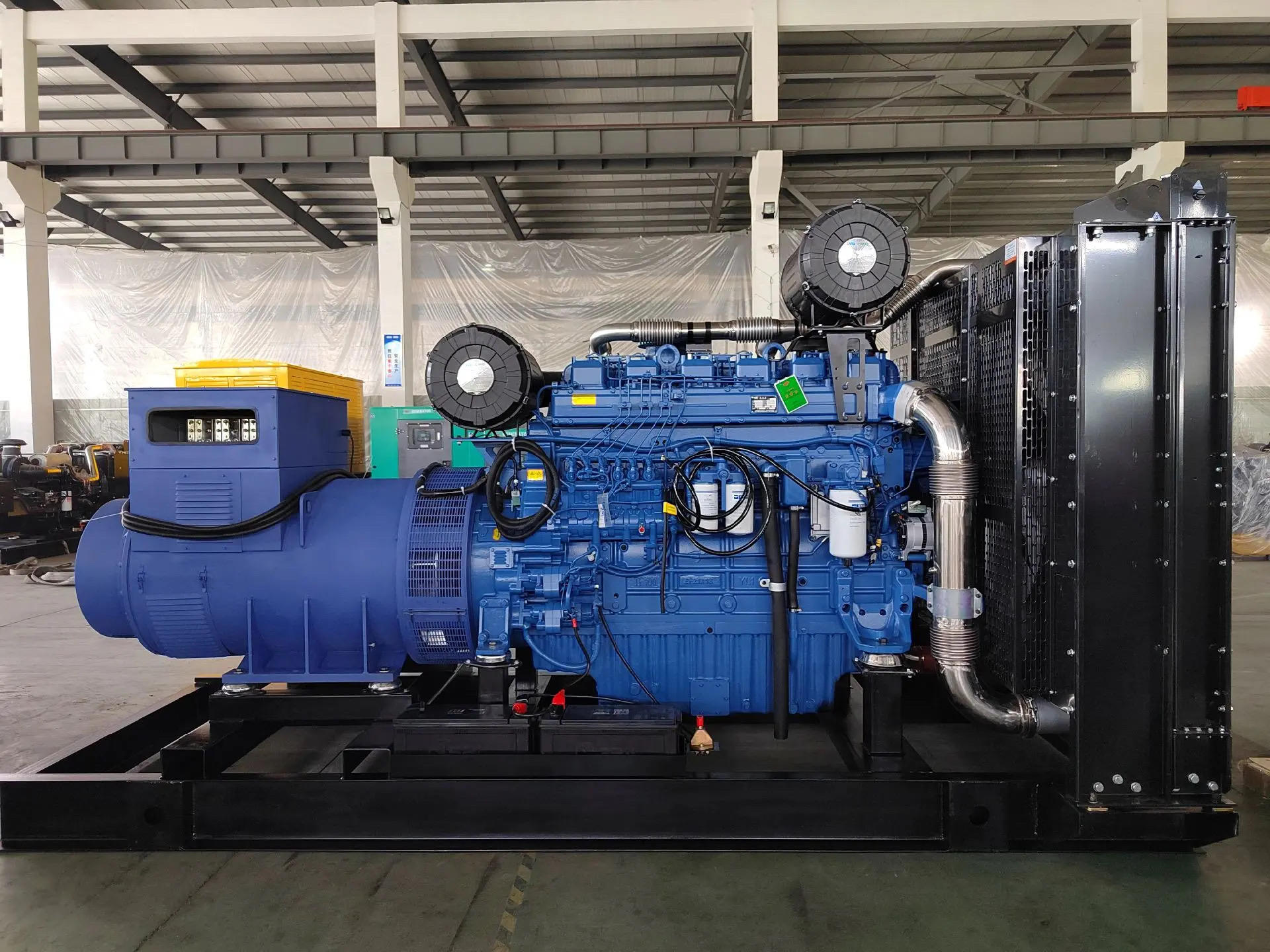
Why is the curve not linear?
Because a share of the fuel goes to overcoming the engine's own friction and driving the cooling fan and the alternator's field, and that share does not fall with the load. At a quarter load those fixed losses are spread over a small output, so the L/kWh figure rises even though the L/h figure falls.
How is the figure converted into L/kWh?
Divide the hourly burn by the power delivered, and the result compares two sets of different sizes. At the rating the arithmetic is 84 L ÷ 400 kWh = 0.21 L/kWh, and at half load it is 46 L ÷ 200 kWh = 0.23 L/kWh. The second figure is higher, which is why a smaller frame running at 70% beats a larger one running at 35% on fuel.
Use the same conversion when a supplier quotes a specific fuel consumption in g/kWh, because the two units travel together in most data sheets. A figure of 210 g/kWh at the rating sits close to 0.25 L/kWh once the density of diesel at 0.84 kg/L is applied, so a data sheet that states one unit and a site that budgets in the other can disagree by 15% before the first delivery. The method behind the declaration is set out in the ISO 8528-1 fuel consumption statement, and Tesla Power measures each curve on the load bank rather than copying a table, and prints both units for that reason.
- L/h at each load step, from the load bank record.
- L/kWh at the same steps, to compare frames.
- g/kWh from the data sheet, converted at 0.84 kg/L.
Which site conditions move the 500kVA generator fuel consumption?
Four conditions move the figure, and each one is measurable before the set is ordered. Altitude thins the air and the engine needs more fuel to hold the same power. High intake temperature does the same. A load with a poor power factor draws more current for the same kW, which loads the alternator without adding useful output. A set that runs cold, below 40% of rating, burns more per kWh and puts diesel into the sump. The same 500kVA generator in prime duty runs loaded and avoids that penalty, which is why Tesla Power reads the duty class beside the fuel figure rather than on its own.
The altitude effect is the one most often missed, because a set sold at sea level is installed at 1,500 m and the fuel figure on the sheet no longer applies. A derating of 12% at that height means the same 400kW needs an engine working 12% harder, and the burn rises with it. The altitude derating figures give the correction for the height above the reference.
| Load step | Power delivered | Fuel burn | L/kWh |
|---|---|---|---|
| 100% of rating | 400kW | 84 L/h | 0.21 |
| 80% of rating | 320kW | 68 L/h | 0.21 |
| 50% of rating | 200kW | 46 L/h | 0.23 |
| 30% of rating | 120kW | 34 L/h | 0.28 |
Worked example: a data hall on a 320kW load
A data hall held 320kW for 20 hours a day and 120kW for four hours, and the site wanted a monthly fuel figure. At 320kW the hourly burn is 68 L/h, so 20 h × 68 L/h = 1,360 L, and at 120kW it is 34 L/h, so 4 h × 34 L/h = 136 L. The daily total is 1,496 L, and a 30 day month is 1,496 L × 30 = 44,880 L.
The same load on a 400kVA frame would run at 80% instead of 64%, and the burn would fall to about 1,310 L a day, a saving of 186 L a day or 5,580 L a month. Tesla Power Equipment runs that comparison on the load profile rather than on the plate, because the answer changes with the shape of the day and not with the size of the set alone. A 500kVA generator for a data hall is therefore chosen on the 20 hour block rather than on the peak, and the fuel contract follows the same block.
How large should the day tank be?
Size the tank on the hours the site needs between deliveries, and add a margin for the delivery that arrives late. A 500 L tank carries the set at its rating for about six hours, and a 1,000 L tank carries it for twelve. A 500kVA generator for the night shift needs the larger tank when the site cannot take a delivery in daylight, and a data hall that runs the set 20 hours a day needs it for the same reason.
The bund matters as much as the volume in most markets, and a bunded tank holds 110% of the contents. The fuel tank sizing notes set out the base tank, the day tank and the bund as three separate items, and a site that mixes them up usually finds the tank too small at commissioning.
Does a full tank lose fuel to evaporation?
It loses very little from a sealed tank with a breather, and it loses more from a half empty one because the vapour space is larger. A tank filled at the end of a run rather than the start carries less moisture through the change of season, which matters more than the evaporation loss itself.
Which fuel figure belongs in the offer?
Three figures belong in the offer: the burn at the rating, the burn at the load the site described, and the tank size that follows. A supplier who quotes only the first is answering a question the site did not ask. Tesla Power quotes the curve against the load profile in the enquiry, and names the L/kWh figure so the set can be compared with a second offer of another size.
The quality of the fuel belongs beside the figure as well. A batch with a high sulphur content burns with more deposit and needs a shorter oil interval, and the fuel specification that applies to the engine is set out in the EU Stage V fuel requirement and in the equivalent national rule. Most 500kVA generator manufacturers will state the sulphur limit on the sheet, and a site that reads it avoids the injector work that follows a bad batch.
How does the fuel contract follow the curve?
A contract built on the rating buys more fuel than the site can burn, which ties up cash and ages the stock. A contract built on the load profile buys what the site uses and keeps the turnover inside the six month window that diesel tolerates. The fuel consumption chart gives the same curve in a form a procurement officer can hold against a delivery schedule.
- Monthly volume from the load profile, not from the plate.
- Delivery interval short enough to keep the stock fresh.
- Sulphur and cetane stated in the contract.
A site that runs the set only during outages needs a different contract again, because the fuel sits for months and the burn is measured in hours a year rather than litres a day. Those sites should buy in smaller batches and treat the tank as a reserve rather than as a working stock. A reserve tank also needs a water drain at the low point, because condensation collects there over a season and the first run after a long stop pulls it into the filter.
Which readings prove the figure after commissioning?
Two readings prove it, and Tesla Power asks for both before it reads a fuel complaint: the burn measured over a known run and the load recorded across the same hours. A site that logs both for a week has a figure it can hold a supplier against, and a figure that matches the curve on the offer within 5%. A figure that misses by more than that points to a load the site did not describe or a set that is not reaching its rating.
- Litres added and the hour meter reading at each fill.
- Load recorded across the same hours.
- Fuel temperature at the fill, because diesel expands.
Chinese 500kVA generator suppliers often quote the best point on the curve, so the paperwork is worth reading against the test sheet. Most 500kVA generator manufacturers publish the four points once asked, and Yangzhou Tesla Power keeps the measured curve beside the serial number. The 500kVA generator quality records for the batch then travel with the set, and the conformity assessment for the site installation starts from the same sheet.
Frequently asked questions about 500kVA generator fuel consumption
At the 400kW rating the answer is about 2,016 L, and at half load about 1,104 L. The figure that matters is the load the site holds, so a set run at 60% for a day burns close to 1,300 L rather than either of the two extremes.
Because the engine's fixed losses do not fall with the load. Friction, the cooling fan and the field current all draw fuel whatever the output, so a small output carries a larger share of them and the figure per kWh rises.
It does not change the burn, and it does reduce the number of deliveries and the risk of running dry. A tank sized on the hours between deliveries also keeps the fuel fresher, because a full tank turns over faster than a half empty one.
It is, slightly, because a prime set runs loaded for longer and a standby set spends more of its life at light load. The prime and standby ratings carry different annual hour limits, and the fuel budget should follow the duty the site actually runs.
It is accurate at the reference conditions the sheet names, which are usually 25 °C air and sea level. A site at altitude or in hot air burns more for the same output, and the correction appears on the derating sheet rather than on the fuel curve.
It can, by running the set closer to 70% of its rating and by removing the load that draws current without doing work. A power factor correction unit and a load that stays in the band both cut the burn, and the second costs nothing but a re-arranged schedule.
Build the fuel budget from four points on the curve and check it against a week of logged data. Send the load profile and the site altitude to our export desk and Tesla Power will return the 500kVA generator fuel consumption figure for your own day, with the tank size that follows. We keep the measured curve beside the serial number, so the next question about fuel starts from a tested figure.